
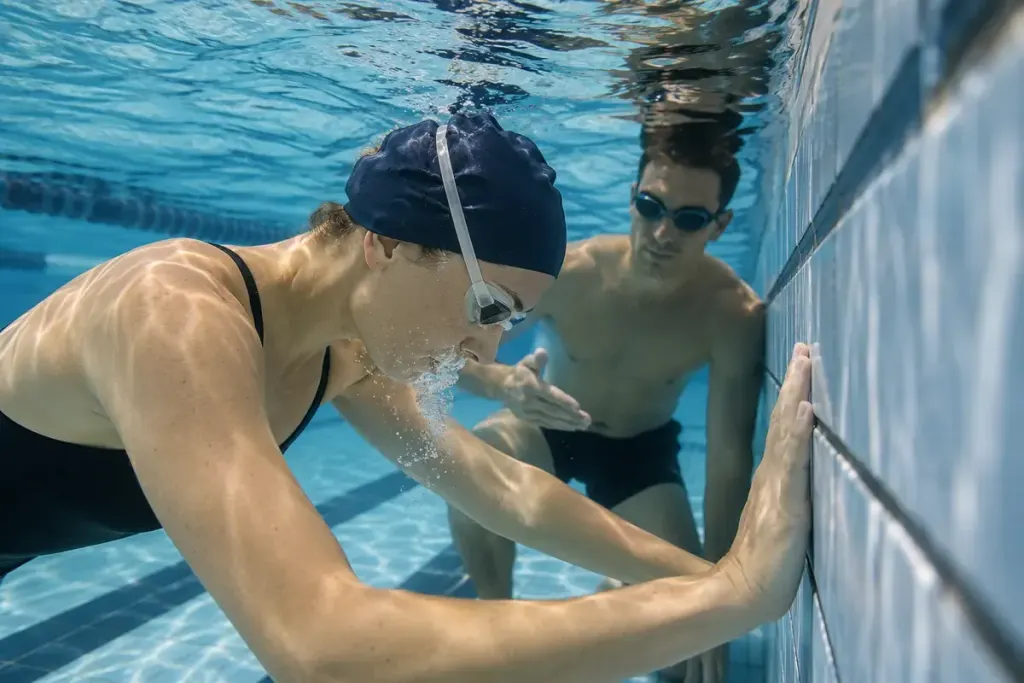
You turn for a breath, but the moment feels rushed because you are still trying to breathe out. Holding air throughout the underwater phase can leave too much to do during the brief turn to inhale.
For a learner, this is best explored with a qualified swimming teacher in a supervised pool. The aim is comfortable coordination, not seeing how long you can stay underwater.
Separate the skill from the full length
Swim England’s front-crawl guidance advises exhaling underwater rather than holding the breath. Ask your teacher to observe what you actually do, because body position, timing and confidence can all affect the experience.
A teacher may begin with a supported exercise at the wall, where you can practise a normal breath, a gentle underwater exhalation and a calm return to breathing above water. Follow their instructions and remain within your ability and the pool’s rules.
Do not practise prolonged breath-holding, hyperventilation or underwater distance challenges. Stop if you feel dizzy, distressed or unwell and alert the teacher or lifeguard.
Notice one change at a time
During a short practice, ask whether you are releasing air before turning, whether you rush the inhale and whether tension increases as the distance grows. These observations are more useful than deciding that you simply have “bad lungs”.
Try the teacher’s adjustment over a manageable distance, rest and discuss the result. Adding speed and distance immediately can hide whether the change helped. A few calmer strokes may be a meaningful improvement even if the next full length is not yet comfortable.
Let the teacher connect the pieces
Breathing interacts with rotation, head position and stroke timing. Avoid forcing a particular breathing pattern because another swimmer uses it. The appropriate exercise depends on your ability and circumstances.
After the lesson, record the cue that helped and the situation in which it worked. Bring that note to the next session. A clear observation gives the teacher a better starting point than another attempt to struggle through the same length without changing anything.