
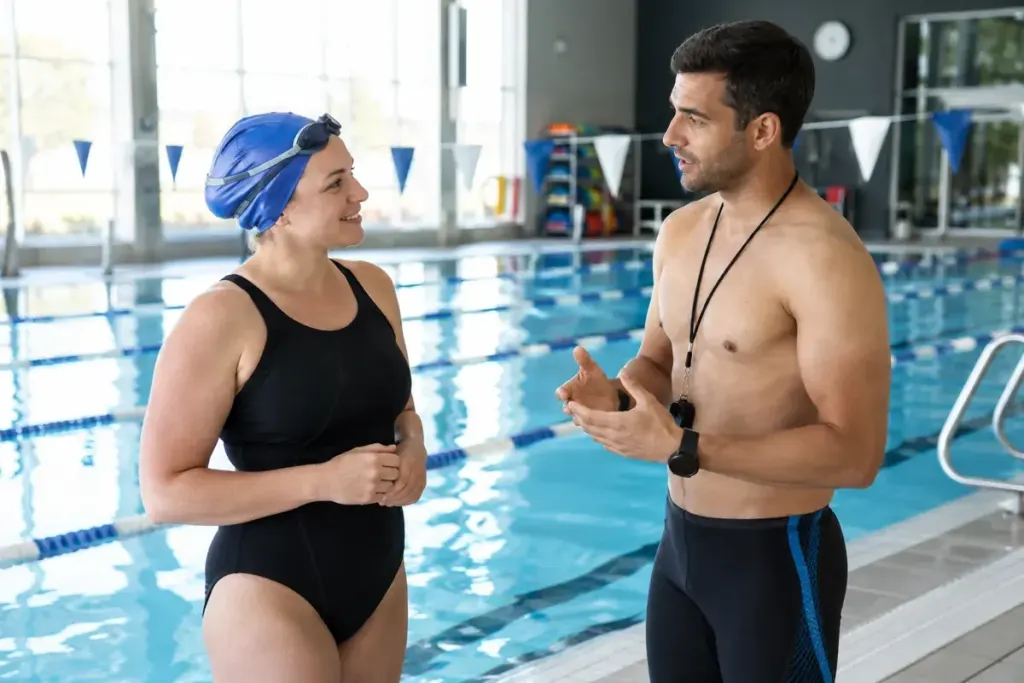
Booking a first swimming lesson can leave you with surprisingly ordinary questions. Where do you meet the teacher? Are goggles required? Does beginner mean never having been in a pool, or already being able to swim a short distance?
Answering those questions before arrival leaves more attention for the lesson itself. You do not need to prove your ability in advance or practise unfamiliar skills alone to deserve a place in a beginner class.
Describe where you are starting
Tell the provider what you can comfortably do and what feels difficult. Be specific without grading yourself: you may be happy standing in shallow water but uneasy putting your face in, or able to move a short distance but unsure how to breathe while swimming.
Swim England’s Adult Swimming Framework recognises different stages of adult learning. A provider’s own level descriptions still matter, so ask how they place learners and whether the suggested class fits your starting point.
Ask about the practical setting
Find out where the lesson takes place, how the instructor meets the group and what changing and access arrangements are available. If you have a disability, a health consideration or a communication need relevant to the activity, discuss suitable arrangements with the provider and an appropriate healthcare professional when needed.
Ask what equipment is supplied and what you should bring. Avoid buying a collection of training aids before the teacher explains which, if any, are useful. Clothing should meet the pool’s requirements and allow you to participate comfortably.
Make arrival less rushed
Check the booking details, route, entry process and any locker requirement. Leave time to find the changing area and ask staff where to wait. Read the pool’s posted guidance and follow the lifeguard’s instructions.
An illustrative preparation note could contain only four lines: class time, meeting place, required items and one thing to tell the instructor. That can be easier to use than a long list of swimming terminology you have not yet encountered.
Agree how to communicate uncertainty
Let the instructor know if you are anxious, cannot hear an instruction or need something demonstrated again. Ask how to pause safely and where to wait. Do not move into water beyond your ability because another learner does so or because you think a beginner should already manage it.
The teacher should guide the session’s skills and progression. Online descriptions can help you understand the context, but they cannot observe your position, breathing or response in the water.
Leave with one clear next step
After the lesson, ask what you should focus on next and whether any practice is appropriate between sessions. Follow the recommended supervision and setting. Pool skills do not automatically establish readiness for open water, where conditions and risks differ.
A useful first session may be about familiarity as much as distance. Keep a brief note of what felt clearer and which question remains. That gives the next conversation with your teacher somewhere concrete to begin.