
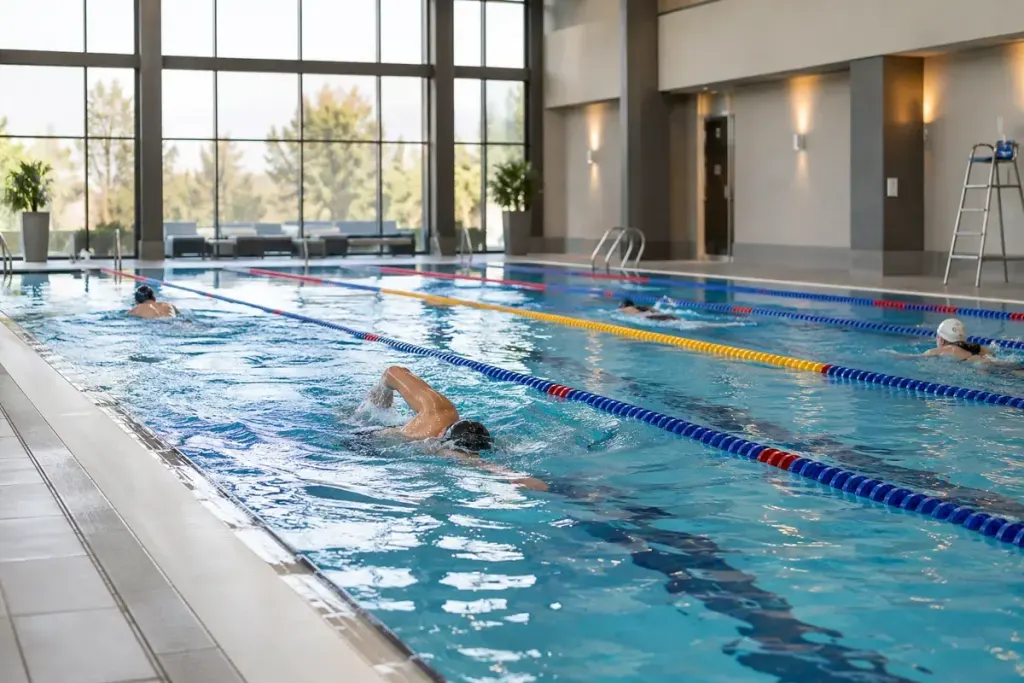
The lane marked medium looks slow for a moment, then several swimmers arrive at the wall together. You are ready to begin, but the direction of travel and the right gap are suddenly less obvious than they seemed from the changing room.
Shared lanes work better when swimmers use the pool’s actual arrangements instead of assuming that every venue follows the same convention. A brief pause to read, watch and ask can prevent a confusing first length.
Start with the signs and the staff
Check lane speed labels, direction boards and any restrictions on equipment or strokes. Watch a few lengths to understand the flow. If you are unsure whether lane swimming suits your current ability, ask the lifeguard or reception staff about an appropriate session.
Swim England’s lane-etiquette guidance recommends choosing a lane suited to ability and speed, following the indicated direction, making room for turns and allowing faster swimmers to pass at the end. It explicitly allows pools to adapt the guidance to their needs.
Choose for today’s swimming
Your lane choice should reflect the pace you are actually swimming, including breaks and changes of stroke. A person doing gentle recovery lengths may need a different lane from the one they use for a faster session. The label is a practical traffic arrangement, not a judgment about the swimmer.
In a hypothetical visit, the medium lane may be much quicker than it was at a quieter time last week. Adjust to the swimmers present and the staff’s direction. If you repeatedly catch others or are repeatedly passed, consider whether another lane is more suitable.
Join without surprising someone
Enter in the permitted way and allow enough room before starting. Avoid pushing off directly in front of an approaching swimmer. Keep awareness of the people around you and follow the local arrangement for passing rather than improvising a manoeuvre in the middle of the lane.
At the wall, move to a suitable resting position that leaves space for others to finish and turn. A conversation with a friend is easier to have outside the active turning area. Do not cling to lane ropes or obstruct them unless an immediate safety need requires support.
Think ahead when changing the session
Training aids, slower drills and a different stroke can alter your speed and the space you use. Check whether the equipment is permitted and whether moving lanes or choosing another session would help. A written workout is not a reason to ignore a crowded pool’s conditions.
If a disagreement develops, ask staff for help rather than making physical contact with another swimmer. Lifeguards are responsible for the venue’s safety arrangements and can explain the expected behaviour.
Leave a little room for learning
Many apparent mistakes come from unclear conventions. A calm question can resolve uncertainty more quickly than guessing what a stranger meant. For adults beginning lessons, our first-session guide covers the questions to ask before entering the water. Familiar routines make a shared pool more welcoming for everyone.