
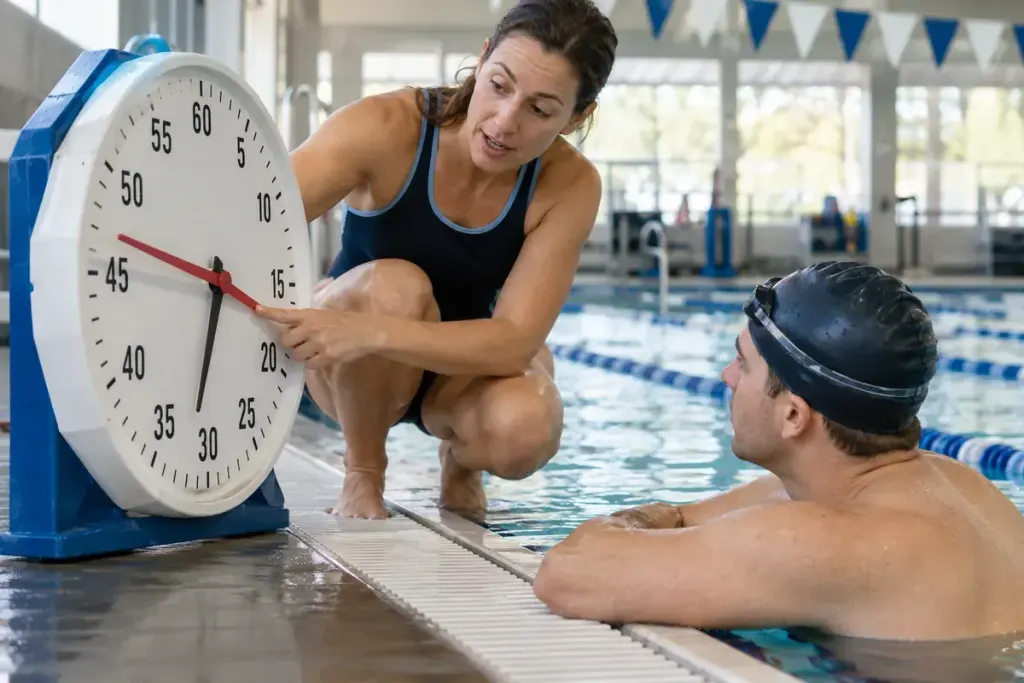
The coach says “leave on the top,” and several swimmers push away together. They are referring to the pace clock, not a place in the lane. Learning that language makes a timed set easier to follow without copying the swimmer ahead and hoping they understood it correctly.
U.S. Masters Swimming’s training guide explains the common clock terms. On a traditional sweep clock, the top is the 60 or zero-second position and the bottom is thirty seconds. A digital clock shows the same seconds directly.
Separate three kinds of time
- Swim time: how long you took to complete the distance.
- Rest: the time between finishing and starting again.
- Send-off interval: the complete period from one start to the next, including swimming and rest.
For a purely illustrative clock example, imagine a two-minute send-off. If a swimmer finishes in one minute forty seconds, twenty seconds remain before the next start. That arithmetic is not a recommended training target; the appropriate distance and interval depend on the swimmer and coach.
Practise reading before adding pressure
From a safe stationary position, identify the seconds hand or digital seconds and follow one complete minute. Ask the instructor which clock the group uses if several are visible. Confirm the pool length and whether the set is written in metres or yards.
Before joining a set, ask how far apart swimmers should leave and what to do if you miss an interval. Do not rush into an occupied space to catch the clock. Lane organisation and safe swimming take priority over a neat number.
If a set leaves too little recovery or your technique deteriorates, tell the coach and adjust appropriately. The clock is a communication tool, not a demand to continue beyond your ability. Understanding it should make the session clearer and calmer, not turn every length into a race.