
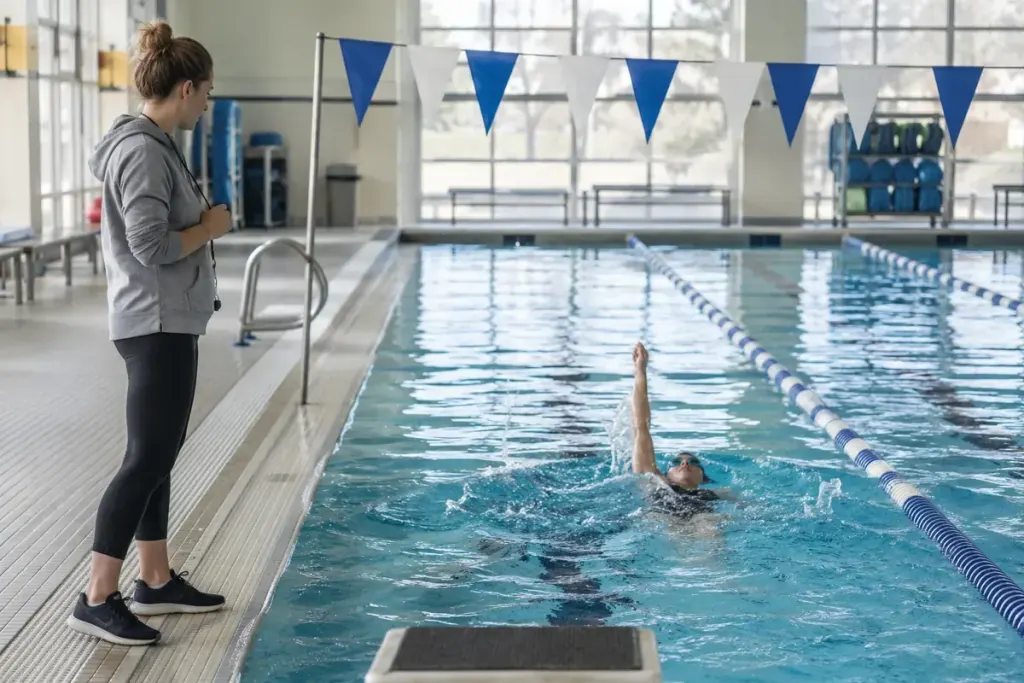
The line of flags above a pool is more than decoration. For a swimmer facing upwards, it provides a visual cue that the end of the lane is approaching. Learning how to use that cue belongs in a supervised lesson, alongside learning how to finish safely.
Swim England’s guide to competitive pools describes backstroke flags positioned five metres from the wall in the pool setup it discusses. Do not assume that every recreational pool has a correctly installed competitive arrangement. Ask your teacher about the pool you are using.
A cue is not a universal stroke count
The number of strokes between seeing the flags and reaching the wall depends on the swimmer and how they are moving. Speed, stroke length, and the point at which the swimmer notices the flags all matter. Copying another person’s number can leave you short of the wall or bring you into it unexpectedly.
Ask the teacher to help you practise the approach at an appropriate pace, with the lane managed for the exercise. Learn the finish they demonstrate before attempting faster swimming or a turn. Do not experiment by closing your eyes or continuing when you have lost your position.
Check the surroundings each session
Lighting, ceiling patterns, and an outdoor sky can make orientation feel different. A new pool deserves a fresh check. If flags are absent or difficult to see, discuss a suitable alternative activity or supervised method rather than relying on a remembered distance.
Stay aware of lane-sharing arrangements and the teacher’s instructions. Flags do not tell you whether another swimmer is immediately ahead, and they do not replace knowing how to stop safely.
With practice, the flags become part of a familiar sequence: recognise the cue, maintain control, and finish as taught. The useful skill is a reliable approach in your own swimming, not memorising a number from someone else’s lap.