
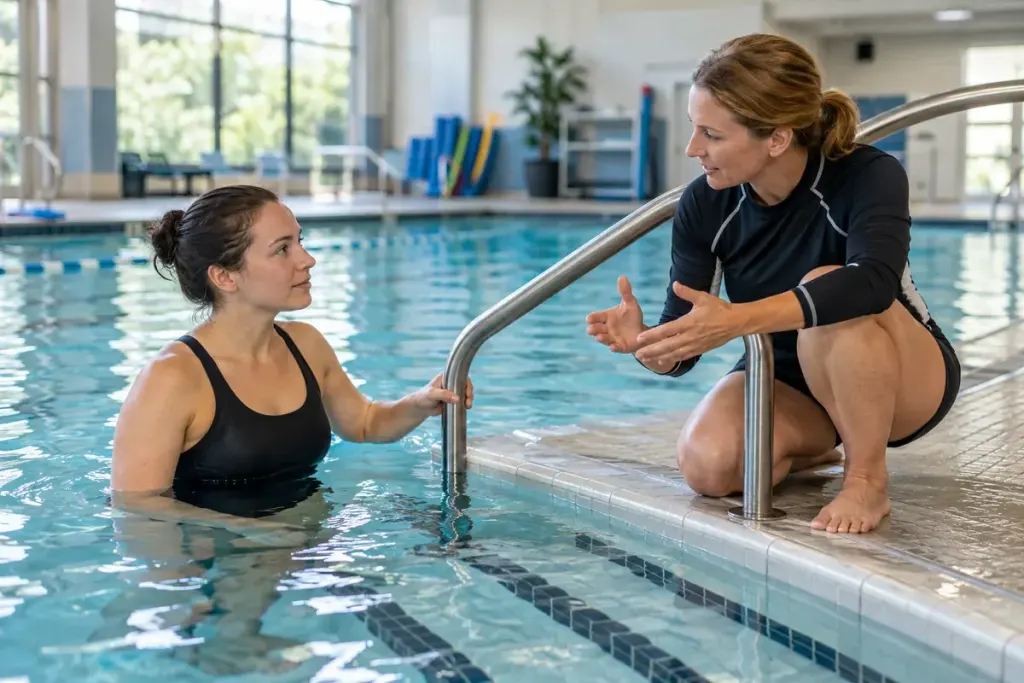
Someone else steps into the pool confidently, and it is tempting to copy them. Their experience, the depth beneath them and the instructions they received may be different from yours.
Ask your instructor how you should enter at the start of the lesson. Explain any concern about balance, mobility, pain or confidence. Choosing an appropriate entry is part of learning, not an obstacle you must overcome before you deserve to join the class.
Clarify the setup first
Confirm the entry point, the water depth and where the instructor wants you to wait. Ask what support is available and how it should be used. Do not assume that a nearby rail, ladder or pool edge is intended for the method you are about to try.
Swim England’s school-swimming resources include different entry and exit methods within supervised learning. The existence of several methods is a reason to seek appropriate instruction, not to experiment unsupervised with each one.
Say when you need a slower explanation
An illustrative request is: “Could you show me where my hands go and where I should stand afterwards?” That gives the instructor a concrete question. If you cannot hear or see the demonstration, ask for it to be repeated before moving.
Never dive into water of unknown depth or where diving is prohibited. Do not treat a jump, dive or unfamiliar entry as a confidence test. Follow the facility’s rules and the instructor’s direction, including waiting until the entry area is clear.
Discuss the exit too. A method that gets you into the water does not automatically provide a comfortable way out. If assistance is needed, agree it in advance with the appropriate staff.
At the next lesson, check again if the lane, pool or equipment has changed. Familiarity with one setting should not become an assumption about another. A calm, clearly understood entry leaves more attention available for the swimming you came to practise.