
You finished the same number of lengths as last week, yet one part of the swim felt calmer. That can be useful progress. Distance is easy to count, but it is not the only thing an adult learner is practising.
Swim England’s adult framework includes confidence, technique and safety. A lesson can therefore have a worthwhile aim that is smaller than another complete length.
Choose the goal with the teacher
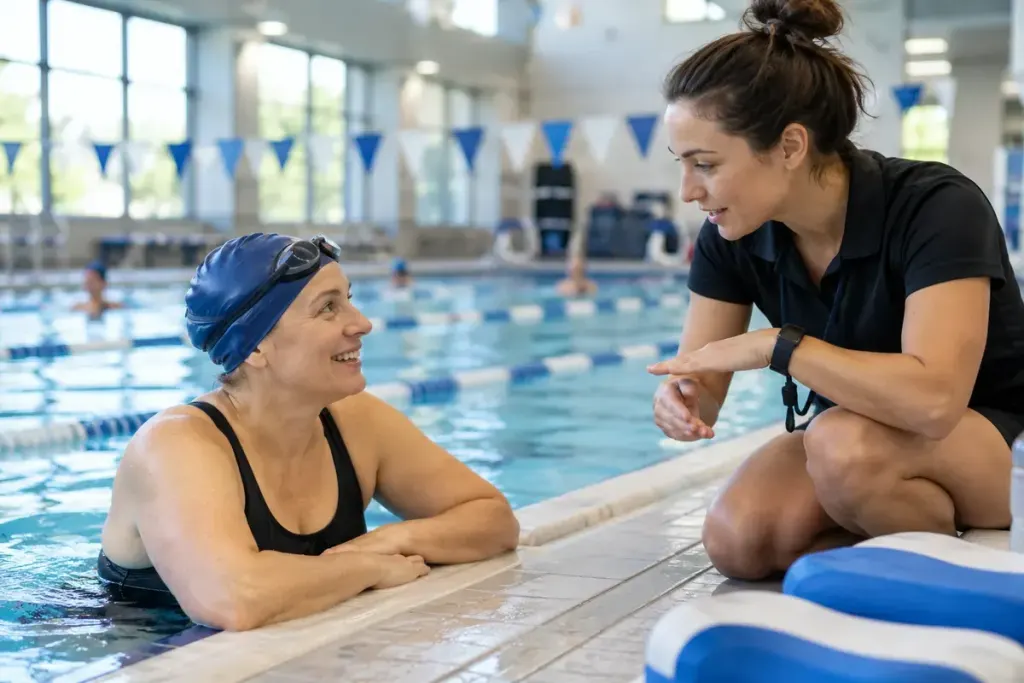
Explain what felt difficult in the previous session and ask which manageable skill to focus on next. The teacher should select an appropriate task, location, support and supervision for your ability.
An illustrative goal might concern recognising the teacher’s cue, approaching a rest point more calmly or repeating an instructed movement with less confusion. It should not become a self-directed challenge involving prolonged breath-holding, deep water or swimming beyond your ability.
Describe what you will notice
“Feel better” is understandable but hard to review. A more observable note might be “I understood when to pause and could explain the next step.” Agree what success looks like without demanding perfect performance on every attempt.
Ask for one piece of feedback at a time where that helps. Trying to remember several corrections simultaneously can make it difficult to know which change affected the movement.
Record the conditions
After the lesson, write the task, support used and the teacher’s next recommendation. A skill performed with an aid or close support should not be recorded as independent competence. That distinction matters when deciding what is appropriate outside the lesson.
Tell the teacher about discomfort, fear or another difficulty rather than hiding it to complete the target. A goal can be revised when the session reveals that a smaller step is needed.
At the next lesson, revisit the note together. Progress becomes easier to recognise when it describes something specific you learned. Another length may come later; today’s useful achievement can be a safer, clearer and more controlled part of the swim.