
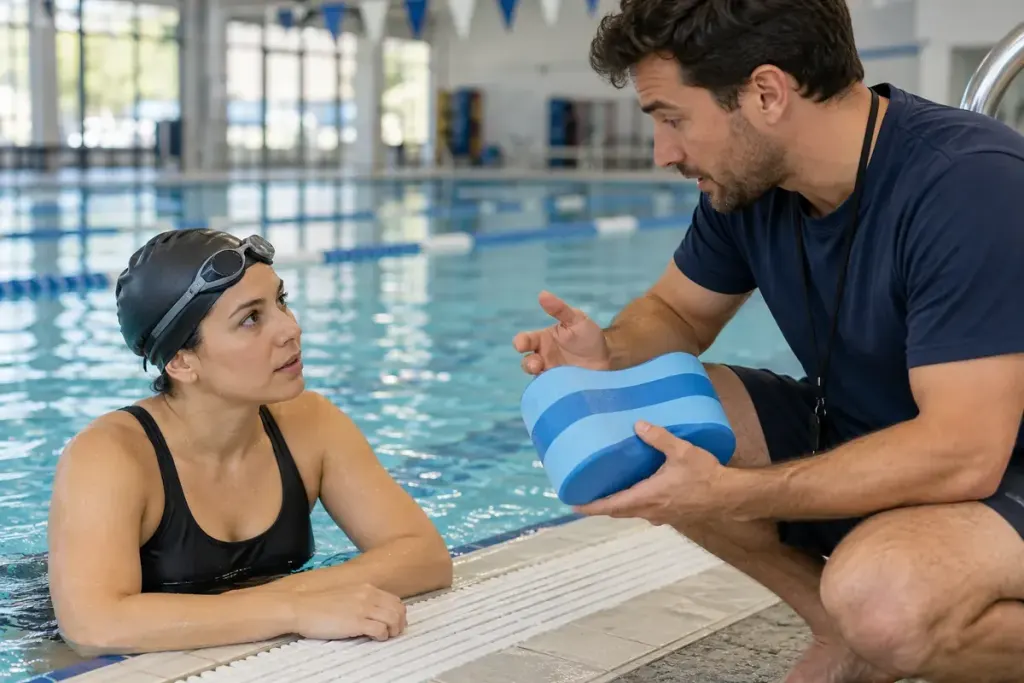
A pull buoy can make the legs feel lighter during a swimming drill. That sensation is useful for some training purposes, but it can also conceal how much the device is changing your usual body position.
It is training equipment, not a substitute for swimming ability or appropriate supervision. Malmsten’s pull-buoy instructions explicitly state that the product is not a lifesaving device.
Know what the drill is trying to teach
Ask your coach whether the purpose is to observe the arm action, practise a particular rhythm or notice body alignment. “Swim with the buoy” is an equipment instruction; it is not yet a learning objective.
Use the product as instructed in a suitable supervised pool. If you cannot swim comfortably without it, work with a qualified instructor on appropriate learning equipment and skills rather than using the buoy to enter deeper water.
Compare the feeling with ordinary swimming
During a manageable coached drill, notice what changes: where the hips sit, whether breathing feels different and whether the stroke becomes strained. Follow the coach’s guidance on returning to normal swimming and consider which part of the feeling transfers without the equipment.
Do not assume a faster length proves that your unaided technique has improved. The buoy supplies support that was absent before. Compare like with like in training notes and identify whether a recorded length used equipment.
If the drill causes pain, excessive fatigue or difficulty breathing, stop and seek appropriate guidance. Avoid adding paddles, ankle restraints or more demanding combinations simply because another swimmer uses them. Those changes can alter the workload and deserve their own assessment.
Rinse, inspect and store the buoy according to its instructions. A damaged or uncomfortable piece of equipment is not worth adapting your movement around. Its job is to support a deliberate practice task, then let you return to swimming with a clearer understanding of that task.